
Claude, Copilot, North or Specialized Intelligence? Choosing the Right AI for the Right Business

Executives face an increasingly confusing AI landscape.
Should we give employees Claude? Deploy Microsoft Copilot? Build agents? Implement Cohere North? Or develop specialized intelligence around our most important decisions?
The answer is not that one technology is better than the others.
They solve different problems.
Understanding those differences may be one of the most important AI decisions an executive team makes.
1. Use Claude when you want to augment the individual
Claude is an extraordinarily capable general-purpose AI.
It is particularly valuable when a professional needs help researching, reasoning, writing, analyzing documents, coding, exploring ideas or solving complex intellectual tasks.
And Claude is no longer simply a chatbot. Enterprise deployments can include connectors, tools, MCP integrations, security controls and agents capable of working across multiple steps.
Its natural starting point, however, is still the person and the task.
Think of a strategy consultant preparing an industry analysis, a lawyer reviewing a contract, a developer examining code or a CFO exploring a financial question.
The professional brings the objective and expertise. Claude dramatically expands what that person can accomplish.
Best question to ask:
How can AI make this person dramatically more capable?
2. Use Microsoft Copilot when you want intelligence embedded into how people already work
Microsoft Copilot becomes particularly compelling for organizations already operating heavily within Microsoft 365.
Its advantage is context.
Microsoft 365 Copilot can work with information from Outlook, Teams, Word, Excel, PowerPoint and Microsoft Graph. Microsoft is extending this further through Work IQ and Copilot Studio, where organizations can create agents, connect additional systems and automate workflows.
The center of gravity is therefore not merely the LLM. It is the Microsoft work environment surrounding it.
A manager preparing for a meeting can have Copilot summarize emails, Teams discussions, documents and previous meetings. An employee can analyze an Excel workbook and turn the results into a presentation without leaving the Microsoft environment.
Best question to ask:
How can AI make our workforce more productive inside the tools we already use?
3. Use Cohere North when you need a secure enterprise AI workspace
North moves further toward Canadian enterprise-wide AI infrastructure.
It combines generative AI, enterprise search, retrieval, agents and workflow automation in a controlled environment. For Canadian organizations with sovereignty, regulatory, or security requirements, North can also be deployed privately, including in a company's VPC or on-premises environment.
This makes North interesting when a Canadian organization wants employees and agents to securely search corporate knowledge, work across internal information and automate workflows without building the entire generative-AI layer itself.
A bank, government organization, or large enterprise, for example, might use North to give employees secure AI access to documents, internal knowledge, and business workflows while maintaining tighter control over deployment and data.
Best question to ask:
How can we provide secure, governed AI and agents across my Canadian enterprise?
4. Develop Specialized Intelligence when the objective is the decision itself
There is another category of problem.
A CFO doesn't only want to find a document or summarize a spreadsheet.
She may ask:
“Where can we realistically improve EBITDA over the next 12 months without putting revenue or operations at unacceptable risk?”
Answering that question reliably can require much more than generative AI.
The system may need to combine:
ERP, CRM and financial transactions
Business rules and company policies
Financial calculations
Price-Volume-Mix analysis
Customer and product profitability
Machine-learning models
Forecasting
Optimization algorithms
Scenario simulation
Operational constraints
Historical decisions
Expert knowledge accumulated inside the organization
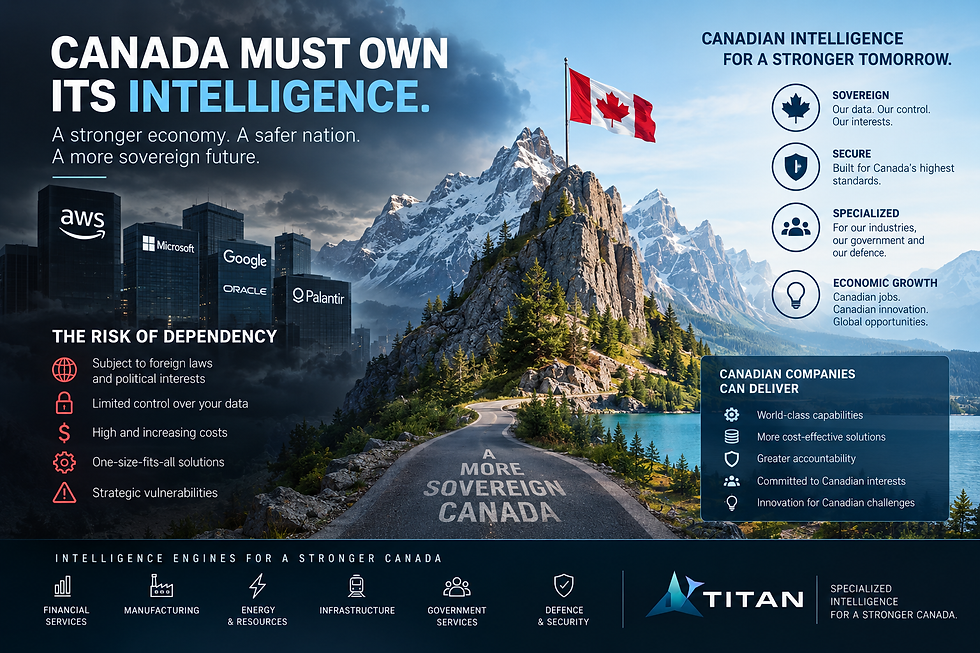
This is the problem we are addressing with TITAN Specialized Intelligence Engines.
The LLM remains extremely important—but its role changes.
Instead of asking the LLM to produce the hard numbers, TITAN can use specialized agents to retrieve them from authoritative systems, tools to calculate them, analytical and ML models to analyze them, business rules to constrain them, and the organization's expertise to interpret them.
The LLM helps understand the question, reason over the available context, and communicate the resulting intelligence naturally.
That distinction matters.
Imagine asking:
“Where are we losing margin?”
A general AI assistant can help a CFO or consultant analyze the information made available to it and identify hypotheses worth investigating.
A Specialized Financial Intelligence Engine can be engineered to continuously interrogate transactions across customers, SKUs, regions, discounts, procurement costs and historical margins; execute predefined analytical models; identify specific anomalies; quantify potential opportunities; and allow the CFO to drill all the way back to the transactions supporting the conclusion.
The objective is no longer simply to help me analyze.
It becomes:
Help our organization understand, calculate, simulate and make this particular class of decisions repeatedly and reliably.
It is not a competition. It is an architecture.
This is perhaps the most important point.
An organization may use all four.
Claude | can augment individual knowledge workers. |
Microsoft Copilot | can bring AI into everyday work and the Microsoft ecosystem. |
Cohere North | can provide a secure enterprise environment for knowledge, agents and workflow automation. |
Specialized Intelligence System | can be engineered around the smaller number of high-value decisions where the organization needs its own data, models, rules, constraints and expertise working together. |
In fact, specialized intelligence does not require rejecting frontier LLMs. A well-designed intelligence architecture can use different models as components depending on the task, deployment requirements, economics and security constraints.
The mistake is expecting one technology layer to solve every layer of the problem.
From AI adoption to intelligence strategy
For executives, I believe the conversation should therefore change.
Don't start with:
“Which AI should we buy?”
Start with:
“What are we trying to accomplish?”
If the objective is individual productivity, deploy powerful general AI.
If it is productivity deeply integrated with Microsoft work, consider Copilot.
If it is secure enterprise-wide AI, knowledge retrieval and agentic workflows, evaluate platforms such as North.
But when the objective is to improve a critical financial, operational, or mission decision unique to your organization, consider whether you need to engineer Specialized Intelligence around that decision.
That leads to a much more important question:
Which decisions in our organization are valuable enough to deserve their own intelligence?
That is where the next chapter of enterprise AI begins.




Great perspective. The key is not choosing the “best” AI, but choosing the right AI for the business problem we need to solve.
The shift from simply using AI to augment people toward building specialized intelligence for critical decisions is particularly relevant for organizations looking to turn AI into measurable business value.