
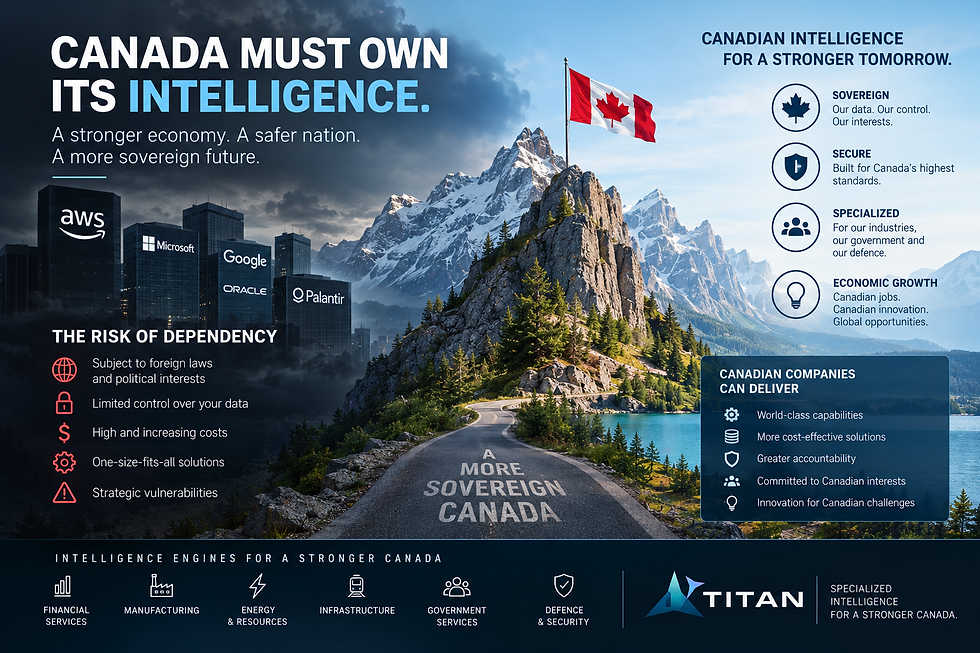
Canada Must Own Its Intelligence

In the age of AI, sovereignty is no longer only about borders, energy or defence equipment. It is also about who controls the intelligence a country uses to make its most important decisions.
For decades, Canada could reasonably assume that deep economic integration with the United States, common security interests and access to American technology would provide a stable foundation for our digital future.
That assumption deserves to be reconsidered.
The geopolitical environment has changed. Canada's own government now speaks explicitly about strategic autonomy, reducing reliance on foreign suppliers and ensuring sovereign control over technologies critical to national security. Its new Defence Industrial Strategy identifies digital systems—including secure cloud and artificial intelligence—as sovereign capabilities Canada should develop domestically.
This raises a question that extends far beyond defence:
If intelligence is becoming one of the most important strategic assets of the 21st century, should Canada outsource its intelligence infrastructure?
I believe the answer is no.
Canada should remain interoperable with American technology and work closely with our allies. But interoperability is fundamentally different from dependency.
Canada should use global technology. It should not become dependent on another country for its intelligence.
We Are Entering the Intelligence Economy
The discussion about AI is evolving too slowly.
We continue talking about models, copilots, chatbots and agents.
But AI models are rapidly becoming building blocks.
The strategically important layer is increasingly what organizations construct around them:
Data + Knowledge + Business Rules + Analytical Models + AI + Decision Frameworks = Specialized Intelligence
That intelligence can understand a company's finances, optimize its supply chain, identify risks, recommend capital-allocation decisions or help military commanders interpret operational information.
That changes the sovereignty discussion.
If Canadian corporations and government institutions increasingly depend on intelligence systems to determine what is happening, why it is happening, what could happen next and what they should do about it, those systems become strategic infrastructure.
We should treat them accordingly.
The Palantir Question
Palantir has demonstrated something extremely important: software can integrate enormous quantities of heterogeneous information and transform it into operational intelligence.
Its platforms have helped establish a category spanning data integration, analytics, AI and operational decision support.
And the United States is investing heavily in this capability. Just this week, the U.S. Army awarded Palantir and Anduril contracts worth roughly $192 million for eight additional TITAN battlefield intelligence systems, which aggregate information, including satellite data, to accelerate battlefield intelligence and targeting.
Canada should learn from this.
But the lesson should not simply be:
“Canada needs Palantir.”
It should also be:
“Canada needs the capability that companies like Palantir represent.”
Those are very different conclusions.
Canada has world-class AI researchers, software engineers, mathematicians, cybersecurity specialists, defence companies and technology entrepreneurs.
Canada has no fundamental reason it cannot build many of these intelligence capabilities itself.
Specialized companies such as Accéder and a broader ecosystem of Canadian technology companies can develop specialized intelligence systems combining data integration, machine learning, LLMs, mathematical models, business and operational rules, simulation, optimization, visualization and decision support.
We will not reproduce every capability of a company with Palantir's scale overnight.
Nor should we try.
The objective should be to develop Canadian Intelligence Engines for Canadian problems, while partnering with allies where their technology genuinely provides capabilities we cannot efficiently reproduce.
That is precisely the logic behind Canada's new Build–Partner–Buy defence strategy: build sovereign capabilities domestically where Canada can; partner where collaboration makes sense; and buy internationally where necessary.
Sovereignty Is More Than Where the Server Sits
There is another misconception Canada needs to confront.
Putting Canadian information in a Canadian data centre does not necessarily make the system sovereign.
The Government of Canada itself acknowledges this.
Its guidance states that when a cloud provider is subject to foreign laws, Canadian data may potentially become subject to those laws regardless of where the servers are physically located. Canada's digital-sovereignty framework specifically identifies legislation such as the U.S. CLOUD Act and FISA as considerations around foreign jurisdiction.
This distinction is critical.
Data residency is not the same as data sovereignty.
And data sovereignty is still not enough.
Canada should think about at least four dimensions:
Data sovereignty — Who ultimately controls the data?
Technology sovereignty — Can Canada operate the technology without depending completely on a foreign vendor?
Intellectual-property sovereignty — Who owns the models, rules, integrations and specialized intelligence created around Canadian institutions?
Operational sovereignty — Can Canada continue operating the capability if commercial relationships, foreign policies or geopolitical conditions change?
That last question has become considerably less theoretical.
Canada's government now defines digital sovereignty partly as the ability to operate independently and reduce reliance on foreign entities. Shared Services Canada is consequently developing sovereign private-cloud capabilities, exploring Canadian vendors, and working with DND on sovereign AI hosting options.
This Is Not an Anti-American Argument
This distinction matters enormously.
Canada and the United States remain deeply integrated economic and defence partners.
American hyperscalers have extraordinary technology, enormous cybersecurity resources, global infrastructure and capabilities that Canadian companies should absolutely use when appropriate.
Trying to replace every Microsoft, Amazon, Google or American defence technology with a Canadian equivalent would be economically unrealistic and strategically counterproductive.
Sovereignty does not mean isolation.
Canada's own Defence Industrial Strategy makes exactly this distinction: build domestically where sovereign capability matters, partner with trusted allies where cooperation creates an advantage, and buy foreign technology where necessary.
The problem is dependency without alternatives.
No strategically important Canadian institution should reach a point where another country's company, laws, infrastructure or political decisions constitute an unavoidable single point of failure.
That is simply prudent national strategy.
There Is Also an Economic Argument
Every dollar Canada spends developing Canadian intelligence capabilities does more than purchase software.
It creates Canadian intellectual property.
Canadian engineering jobs.
Canadian AI expertise.
Canadian cybersecurity capability.
Canadian defence technology.
Canadian companies capable of exporting intelligence solutions.
And Canadian strategic autonomy.
Canada's government estimates that its broader Defence Industrial Strategy can unlock $180 billion in defence procurement opportunities and $290 billion in defence-related capital investment over the coming decade. Its goal is eventually to award 70% of defence acquisitions to Canadian firms.
The question is where that money creates the greatest long-term leverage.
Artificial intelligence, secure cloud, sensors, autonomous systems and intelligence software should be near the top of that list.
Because software has an unusual economic characteristic:
Once Canada develops the intellectual property, we can deploy it repeatedly and export it globally.
Canada should not merely be a consumer of the intelligence economy.
We should become a producer.
Canadian Companies Can Compete Differently
Canadian technology companies do not need to beat American hyperscalers by becoming larger versions of them.
We can compete through specialization.
A hyperscaler needs technology capable of serving millions of organizations.
A Specialized Intelligence Engine can be engineered around one industry, one organization or even one mission.
That creates another model:
Instead of: Buy a gigantic platform → hire consultants → configure everything → adapt your organization to the technology
We can increasingly offer: Understand the mission → integrate the relevant data → encode expert knowledge → implement the required analytical models → configure specialized intelligence → deploy where the organization requires it.
Cloud.
Private cloud.
Canadian sovereign infrastructure.
Or on-premises where the sensitivity of the mission demands it.
For some applications, that approach can potentially be more focused, less complex and less expensive than deploying a broad platform and then customizing it extensively.
Not always.
But often enough that Canadian organizations should be required to ask:
Can a Canadian company provide this capability before we automatically send the requirement abroad?
That is how domestic champions are created.
Business Sovereignty Matters Too
This discussion cannot stop at the Department of National Defence.
Canadian banks, manufacturers, energy companies, telecommunications providers, mining companies and critical-infrastructure operators increasingly depend on AI for important decisions.
Imagine that ten years from now the intelligence behind Canadian banking, manufacturing, energy, logistics and defence resides predominantly inside systems controlled by foreign technology providers.
Canada may still own the companies.
We may still own the physical infrastructure.
We may even technically own the data.
But an increasingly important part of the intelligence used to operate those assets would belong to an external technological ecosystem.
That should concern Canadian CEOs as much as policymakers.
From Artificial Intelligence to Canadian Intelligence
Canada was one of the countries that helped create the modern AI revolution.
But scientific leadership does not automatically translate into economic or strategic leadership.
We now have an opportunity to take the next step.
Not simply to develop more AI models.
To develop Canadian Intelligence.
Financial Intelligence.
Industrial Intelligence.
Energy Intelligence.
Supply Chain Intelligence.
Cyber Intelligence.
Defence Intelligence.
Intelligence designed around Canadian organizations, Canadian requirements and Canadian strategic interests—while remaining interoperable with our allies and the best technologies in the world.
The Government of Canada has already begun moving in this direction. Shared Services Canada says it is working toward a sovereign made-in-Canada AI platform and Canadian sovereign cloud capabilities precisely to reduce vendor concentration and strengthen domestic technological capacity.
Now Canadian industry needs to rise to the challenge.
Intelligence Is Sovereignty
The defining strategic question of the next decade may not be:
Who has access to the best AI?
Most advanced economies eventually will.
The more important question will be:
Who owns the intelligence built with it?
For businesses, that intelligence will increasingly determine competitiveness.
For governments, it will influence economic sovereignty.
And for defence organizations, it may determine decision advantage when minutes—or seconds—matter.
Canada should continue buying the best technology in the world.
Canada should continue collaborating deeply with the United States and our other allies.
But when the capability is strategically important, and Canada has the talent to build it, we should build it here.
Our data. Our intellectual property. Our technology. Our intelligence. Under Canadian control.
Because in the intelligence economy, a country that cannot control its intelligence cannot fully control its future.
Canada must not only be AI-enabled.
Canada must become intelligence sovereign.


Comments